





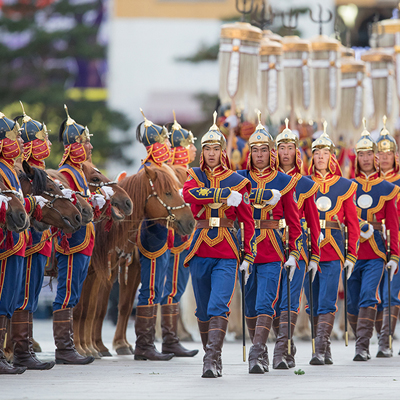
.jpg)


Famous Mongolians

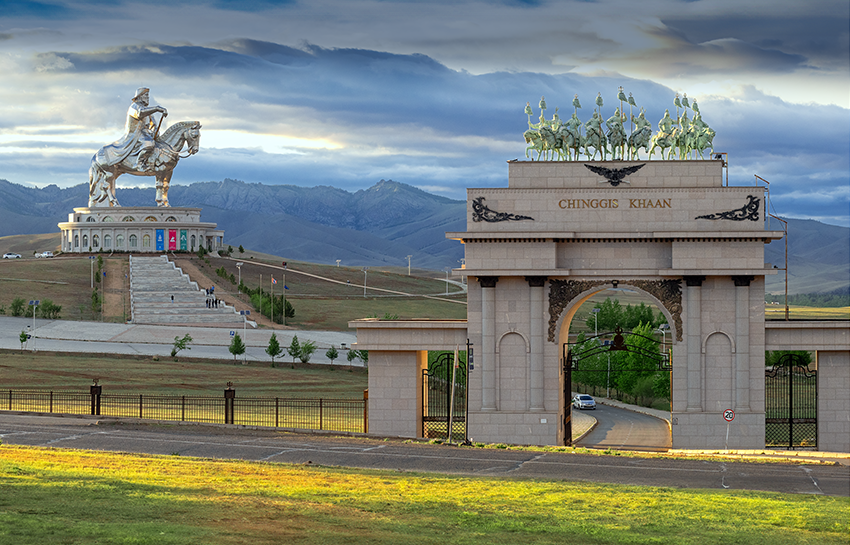
Chinggis Khan - Man of Millennium
Mongolia is home country of Chinggis Khan, the emperor who conquered the world on horseback. Chinggis Khan was chosen as “Man of Millennium” even 800 years after he enthroned as King and established the Mongol Empire in 1206. No doubt that every single person around the world wants to travel to Mongolia and explore homeland of the Great Emperor.
Chinggis Khan was born in 1162 in Deluun Boldog, near the mountain Burkhan Khaldun and the rivers Onon and Kherlen. His original name was Temujin and son of Esukhei. In 1206, Chinggis Khan was acknowledged as Khan of the consolidated tribes and took the new title “Chinggis Khan”.
Chinggis Khan’s empire was the second largest empire in the world, being overshadowed by only British Empire of the late 19th century. Mongol Empire covered 9.15 million square miles, which is more than 16 percent of the entire world. In world history, 13th to 14th century is also considered as Era of Mongolia.

The Kublai Khan (1215-1294) – the greatest successor of Chinggis Khan
Kublai founded the Yuan dynasty in China as a conquest dynasty in 1271, and ruled as the first Yuan emperor until his death in 1294. Kublai Khan was the fourth son of Tolui, the youngest of Genghis’s four sons. He began to play an important part in the extension and consolidation of the Mongol empire only in 1251, when he was in his mid-30s. In May 1260, his associates held a “great assembly,” and Kublai was unanimously elected khan.
Kublai’s achievement was to reestablish the unity of China, which had been divided since the end of the Tang dynasty (618–907). He instituted a “nationalities policy” under which the population of China and his reign was a time of toleration for rival religions and of economic privilege for the favoured religions. Kublai celebrated—mainly because of Marco Polo’s account—for his use of paper money. Though Kublai was celebrated above all as a Chinese emperor, he also helped to form the political traditions of his own Mongol people.

Bogd Jivzundamba Zanabazar (1635-1723)
Zanabazar (1635-1723) was the first high saint (Ondor Gegeen) of Mongolia. Although he was born to an aristocratic Khalkha Mongol family, Zanabazar is remembered today not for his privileged background, but for using his immense talent and charisma to propagate Buddhism and benefit his fellow countrymen.
Widely regarded as the “Michelangelo of Asia”, Zanabazar was a renowned painter, sculptor, architect and costume designer. His artistic skills were matched by his literary prowess as a Buddhist scholar, linguist and poet. Historians say that he single-handedly ushered Mongolia into a period of cultural renaissance. In addition to these talents, Zanabazar was a charismatic leader and an astute politician. Zanabazar’s use of his artworks as a tool of diplomacy was crucial to the survival of the Khalkha Mongols and the influence they wielded. Today, almost three centuries after his death, Zanabazar continues to inspire many to achieve their personal best and to be a beacon of light and hope.
Zanabazar was an active role in the construction of monasteries and temples in the Mongol styles with influences from East Asia. Zanabazar earned his place in art history by innovating the static artistic model of eastern and Buddhist works through combining religious and traditional folk arts by replicating the human figure, enriched by the traditional Mongol concept of beauty in his representations of deities.

The Bogd Khan - the spiritual leader of Mongolia's Tibetan Buddhism
The Bogd Khan (1869–1924) was enthroned as the Great Khaan (Emperor) of Mongolia on 29 December 1911, when Outer Mongolia declared independence from the Qing Dynasty.
He was born in the Kham region of eastern Tibet, today's Sichuan province of the People's Republic of China. As the eighth Jebtsundamba Khutuktu, he was the third most important person in the Tibetan Buddhism hierarchy, below only the Dalai Lama and Panchen Lamas, and therefore also known as the Bogdo Lama.
The Bogd Gegen lost his power when Chinese troops occupied the country in 1919. When Baron Ungern's forces failed to seize Urga in late 1920, the Bogd was placed under house arrest; then he was freed and reinstated by Ungern shortly before he took Urga in 1921. After the revolution in 1921 led by Damdin Sükhbaatar, the Bogd Khan was allowed to stay on the throne in a limited monarchy until his death in 1924
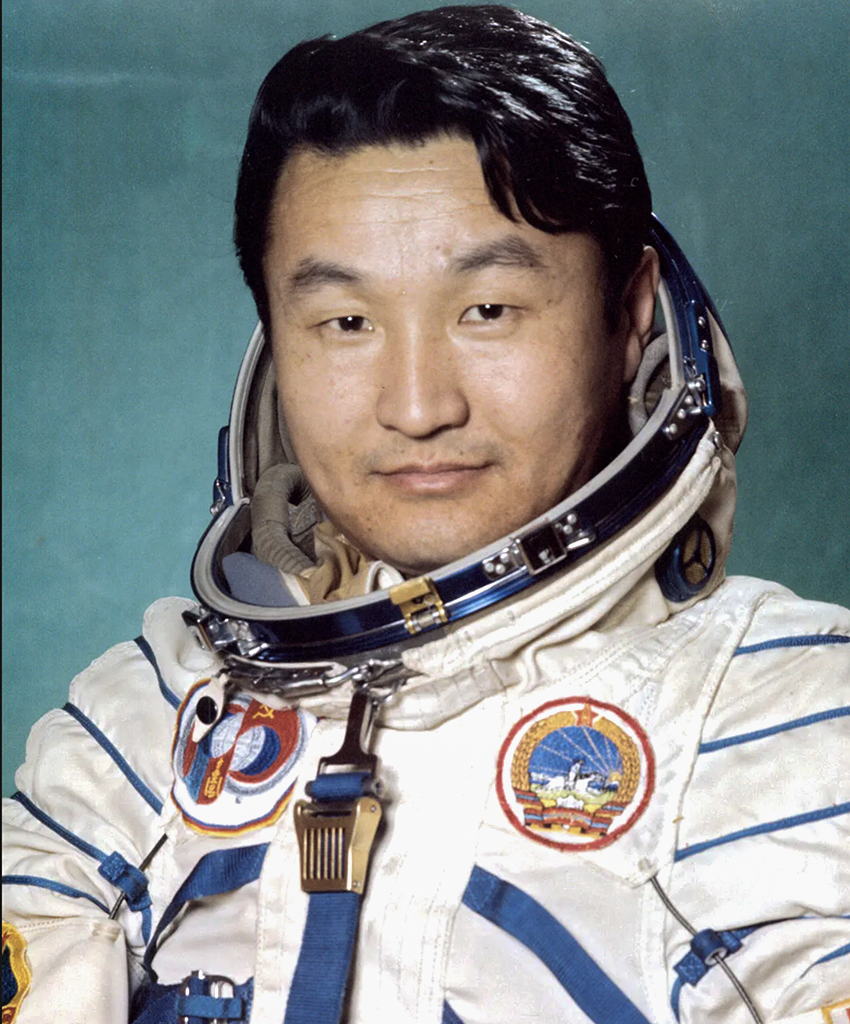
Jügderdemidiin Gurragchaa – First Mongolian in Space
Jugderdemidiin Gurragchaa was the first Mongolian in space. Born in Gurvanbulag, Mongolia, Gurragchaa studied in Ulan Bator to become an aerospace engineer. He was selected as part of the eighth Intercosmos program on March 1, 1978. Gurragchaa, along with Soviet cosmonaut Vladimir Dzhanibekov, departed from Baikonur Cosmodrome on March 22, 1981.
While in orbit, Dzhanibekov and Gurragchaa carried out experiments on earth science. After 124 orbits and 7 days, 20 hours and 42 minutes in space, Gürragchaa and Dzhanibekov landed 170 km southeast of Dzhezkasgan. Thus, Mongolia has become the tenth country to send an astronaut into space and J. Gurragchaa - the hundredth astronaut of the world.


